
The Truth About Radon: Hidden Home Radiation That Raises Lung Cancer Risk
Radon is a naturally occurring radioactive gas that forms from the decay of uranium in the Earth’s crust. It is present in the soil and can enter residential buildings through their structures. It is the leading cause of lung cancer among people who have never smoked.
Radon’s effects are unnoticeable and do not cause symptoms, so it is not perceived as a risk factor in everyday life, even though it may be present in the home.
Radon levels are determined by the conditions of each individual home, and the associated risk develops with prolonged exposure.
Sources and Entry Pathways
The main source of radon in a home is the soil beneath the building. It determines indoor radon levels in the vast majority of cases.
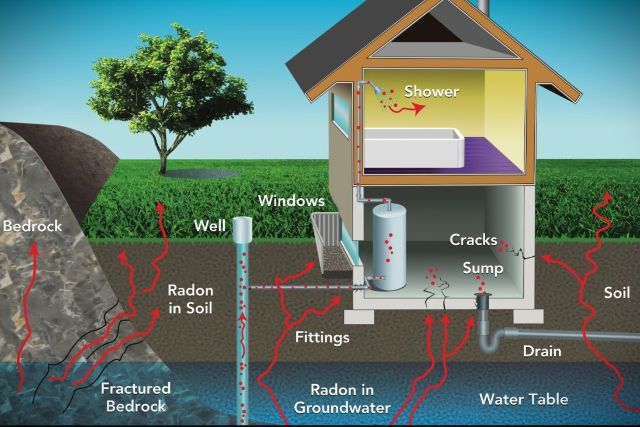
Radon moves through small spaces between soil particles and cracks in the ground, then enters the home through structures that are in contact with the earth. This does not happen occasionally but continuously: the gas rises from beneath the building and is drawn inside through structures that are in contact with the soil. The movement of the gas is caused by pressure differences between the soil and the indoor environment, allowing radon to be drawn inside through any available pathways.
The rate of entry depends on the condition of the building’s structure. Good sealing can limit the flow, but in practice, structures rarely remain completely airtight. Over time, cracks and gaps develop in foundations. Their formation is associated with building aging, settlement, structural loads, and geological factors, including seismic activity.
The main entry pathways are foundation cracks, joints between slabs, openings around pipes, and components of drainage systems. Even small defects can allow a continuous inflow of gas.
Other sources exist, but their contribution is generally much smaller and does not account for the main flow of gas into the building. Water from underground sources may contain dissolved radon, although this is mainly relevant when private wells are used. Building materials, such as granite, may release small amounts of radon, but under typical conditions, they do not determine the overall indoor level. Sewer systems are not a source of radon under normal operating conditions, and additional entry is possible only when their seals are compromised.
Accumulation and Indoor Levels
Indoor radon levels are determined not only by the entry of the gas but also by how effectively it is removed from the home. With a continuous inflow from the soil, the concentration depends on the balance between the amount of gas entering and the amount being removed.
A key factor affecting radon levels, all other conditions being equal, is ventilation. When air exchange is insufficient, radon remains indoors and its concentration increases. The less frequently indoor air is replaced with fresh air, the more radon can accumulate.
Building airtightness increases this effect. Modern energy-efficient homes generally have lower air exchange rates when adequate ventilation is not provided, creating conditions for gas accumulation.
The highest levels are often found in basements and on lower floors, where concentrations may be elevated because of proximity to the source and limited air exchange. Using a basement as living space increases the duration of exposure for its occupants.
Radon concentrations are not stable and change over time. They depend on ventilation operation, weather conditions, and the season. Levels are generally higher during colder months because windows are closed and air exchange patterns change.
Even within the same home, radon levels may differ between rooms depending on ventilation conditions and location.
Radon in Well Water
Water from underground sources may contain dissolved radon because the gas is present in the soil and rocks through which the water passes. This is mainly relevant to private wells, while radon concentrations in municipal water supply systems are generally much lower.
The main risk is associated not with drinking the water but with radon being released into the air during its use. During showering, laundry, and other household activities, the gas moves from the water into the indoor air and increases its concentration.
The contribution of water to overall indoor radon levels is usually smaller than that of radon entering from the soil, but at high concentrations in well water, it may become a significant additional source.
A separate radon water test is used for assessment, but the priority is to measure radon levels in indoor air, because inhalation of radon and its decay products presents the primary risk.
Reducing radon in water involves removing it before the water enters the home. The main method is aeration - treating water with air so that dissolved radon is released from the water and vented outdoors. Activated carbon filters may also be used to capture radon, but these systems require proper selection and monitoring, including because radioactive substances can accumulate in the filter.
In Canada, systems for removing radon from water are not installed by default. Aeration or filtration is used when elevated radon levels are detected in the water.
Radon Guidelines
Historically, Canada’s approach to radon guidelines was less strict. Before 2007, the reference level was 800 Bq/m³ - a level at which significant exposure was effectively considered acceptable, and most measurements formally remained within the recommended limit.
The current recommended level is 200 Bq/m³. Bq/m³ (becquerels per cubic metre) is a unit used to measure the radioactivity of radon in a given volume of air. This value is not a safety threshold but is used as the level above which action to reduce radon concentrations is recommended. Values below this level do not mean that there is no risk, but only indicate a lower degree of exposure.
For comparison, the World Health Organization (WHO) recommends aiming for a level of approximately 100 Bq/m³, while the U.S. Environmental Protection Agency (EPA) uses an action level of 148 Bq/m³ (4 pCi/L). These values reflect a more cautious approach to risk assessment.
In Canada, radon recommendations are not accompanied by mandatory testing of all residential homes or systematic monitoring, which limits their practical implementation.
Geography and Prevalence
Radon distribution across Canada is uneven and is associated with the geological characteristics of different regions. Higher levels are more frequently recorded in Manitoba, Saskatchewan, Alberta, and New Brunswick, where the proportion of homes with concentrations above 200 Bq/m³ exceeds the national average.
Across Canada, according to recent estimates, approximately 18% of homes have radon levels above 200 Bq/m³, more than twice the previous national estimate of approximately 7%. This is associated with the use of more comprehensive data and modern analytical methods, rather than an increase in radon concentrations in the homes themselves. In light of the new data, Canada is planning to expand radon testing programs, and mandatory testing for various categories of buildings is being discussed, with the possibility of extending it to residential homes in the future. At the same time, experts emphasize that reliable radon assessment requires long-term testing lasting at least three months, as this allows the average gas concentration to be assessed over an extended period. Short-term tests may be used for preliminary assessment but do not replace a full measurement.
In British Columbia, there are significant regional differences. In the interior regions (Interior BC), including Okanagan and Kootenay, elevated radon levels are much more common than in coastal areas such as Lower Mainland and Vancouver Island.
Even within the same province, radon levels can vary considerably between homes because of differences in soil conditions and building structures.
Mandatory radon testing is not required for all residential homes in Canada, so geographic information helps assess regional risk but cannot determine the radon level in a particular home.
Mechanism of Exposure
Radon affects the body primarily through its decay products - radioactive substances formed as radon breaks down. Their tiny particles may attach to dust and other suspended particles in the air and enter the respiratory tract during breathing.
After entering the lungs, they settle on the surface of the bronchial epithelium - the layer of cells lining the inside of the bronchi. During further radioactive decay, alpha particles are released. These particles have high energy but can travel only very short distances through tissues. Therefore, the damaging effects occur directly near the place where the particles are released.
Alpha radiation damages DNA - the molecule containing a cell’s genetic information. The body can repair some of this damage, but certain changes remain. With prolonged exposure, changes in DNA may accumulate and interfere with normal cell function.
This creates conditions for normal cells to become cancerous and is the basis for the development of lung cancer.
The presence of airborne particles also plays an additional role. The higher the level of dust and other suspended particles, the more radioactive radon decay products may be carried with them and retained in the respiratory tract.
Clinical Consequences
Radon is associated with an increased risk of lung cancer and is considered one of the major risk factors for the development of this disease in the general population.
Among people who have never smoked, radon is the leading cause of lung cancer. In smokers, the risk is significantly higher because of the combined effects of radon exposure and tobacco smoke.
The risk increases with higher radon concentrations and longer periods of living under exposure conditions. In other words, both the radon level in the home and the total amount of time a person has been exposed to it are important.
Radon increases the risk of lung cancer overall and is not associated exclusively with any single type of this disease.
Clinical Limitations
Radon exposure does not cause specific symptoms that would make it possible to identify its presence or assess the degree of radiation exposure. During the period when damage is accumulating, a person does not notice changes in their health.
Radon is a source of ionizing radiation - radiation capable of damaging molecules and cells in the body. Its effects are primarily associated with radiation exposure to the tissues of the respiratory tract and cannot be felt by a person.
Currently, there are no routine medical tests that can reliably identify or quantify past radon exposure in a person without symptoms. Blood tests and other laboratory investigations do not show how much radon a person has inhaled.
X-rays, computed tomography (CT), and other medical imaging methods also cannot determine the degree of radon exposure or detect early damage specifically attributable to it. Such examinations are performed when medically indicated, not to measure radon exposure.
There is no established stage with characteristic signs that would allow radon-related damage to be diagnosed before the disease develops.
Therefore, a medical examination cannot reliably establish how much radon exposure a person has experienced. To assess living conditions, it is necessary to measure radon levels directly in the indoor environment.
Radon Testing and Risk Assessment
Radon levels are measured using a special device called a radon detector.
Detectors can be obtained through special testing programs, purchased online or at home improvement stores, or ordered through laboratories that perform the analysis.
Two types of tests are used:
- Long-term test - a small passive detector that is left indoors for three months or longer. It is then sent to a laboratory, where the average radon level is calculated;
- Short-term test - a device that operates for 2 to 7 days. It provides a quick result but depends on current conditions and does not reliably determine the average radon level over an extended period.
The test is placed in a room where a person spends a significant amount of time, usually on the lowest occupied level of the home. The device is positioned 0.5-2 metres above the floor, away from windows, doors, and ventilation.
During testing, the home is used as usual. The normal ventilation routine should not be deliberately changed, as this may affect the measurement result.
The result of a long-term test shows the average radon concentration over the measurement period. Risk increases with higher levels and longer exposure.
If radon levels exceed recommended values, the next step is to contact a radon specialist to assess the home and select a system to reduce the concentration.
Irreversibility of Exposure
Radon is a source of radiation exposure, and radiation exposure that has already occurred cannot be undone.
There is no treatment or special procedure that can eliminate all previously occurring DNA damage or guarantee the prevention of its possible consequences.
However, reducing indoor radon levels stops or decreases further exposure, which is important for reducing future risk. Therefore, even after many years of living in a home with elevated radon concentrations, measures should be taken to reduce those levels.
Conclusion
Radon is a radioactive gas that can enter residential buildings from the soil. It has no colour or odour and causes no noticeable symptoms, but prolonged exposure increases the risk of developing lung cancer.
What you need to remember:
- Radon can be present in any home, regardless of the building’s age, condition, or location;
- Radon levels can only be determined through a special test. Long-term testing lasting at least three months is recommended;
- In Canada, the recommended level is 200 Bq/m³, but risk also exists at lower concentrations;
- Medical examinations cannot determine the degree of radon exposure or detect early damage caused by it;
- Elevated radon concentrations can be reduced using specialized systems that prevent the gas from entering the home.
Most importantly: Do not wait for symptoms to appear or rely on test results from neighbouring homes. The only reliable way to determine the radon level in your own home is to conduct testing.